Engage Students in Community-Based Learning
Created by Cory Sprinkel, Morgridge Center for Public Service & Molly Harris, L&S Instructional Design Collaborative.
This was the most impactful course I have had so far! I was able to connect with new organizations and make a meaningful impact within these organizations and with my projects.
Providing students with opportunities to meaningfully apply their learning and skills to community interests can lead to transformative outcomes for their learning and development. Community-Based Learning (CBL) improves students’ critical thinking and civic responsibility (Strage, 2000), their ability to understand the course material (Fisher et al., 2017), and their development of relevant career skills (Otto & Dunens, 2024). Instructors and community partners benefit from these partnerships, too. For instructors, students in CBL courses tend to be more engaged and motivated by the course work and projects (Maxwell, et al., 2025). And instructors often find their experiences teaching such courses to be both personally and professionally rewarding (Hou, 2010). For community partners, these courses often support an organizational mission of engaging young adults and can increase the organization’s capacity to advance their work (Tryon, Hilgendorf, & Scott, 2009).

L&S Design for Learning Series
In This Article
What’s effective?
Community-Based Learning courses at UW–Madison are formally defined as credit-bearing educational experiences that integrate meaningful community service with guided reflection to enhance students’ understanding of course content, as well as their sense of civic responsibility. Designing a CBL course requires thoughtful planning and execution, including developing mutually beneficial relationships with a community partner, incorporating reflection opportunities for students, and preparing students to engage in an environment that is different from the typical classroom. Below are some of the key things to keep in mind if you choose to incorporate CBL.
At UW–Madison, we are lucky to have on campus the Morgridge Center for Public Service, which offers resources, consultations, workshops, and funding to support CBL. Be sure to check out the offerings from the Morgridge Center if you are interested in CBL.
1. Develop Reciprocal Relationships
CBL should offer reciprocal benefits to both students and the community. Therefore, it is essential that the instructor foster an effective relationship with the community partner and collaboratively develop the engagement, tailoring the project to meet the unique needs of the community partner, while also weighing the learning needs and capacities of students (Tryon, Madden, & Sprinkel, 2023). This degree of collaboration requires intentional planning. While community organizations have expressed that these partnerships helped their agency fulfill needs and accomplish their mission, many also expressed a desire for increased communication and stronger commitment from students and faculty (Karasik & Hafner, 2021). One strategy for developing more equitable partnerships is for the instructor and community partner to develop a partnership agreement to guide the project and clarify the expectations and outcomes of the partnership. This is also a helpful document to share with students to deepen their understanding of the collaboration.
Supporting a reciprocal relationship also means uplifting the unique knowledge and contexts of the given community. Just as students rigorously engage with peer-reviewed scholarship and theory, so too should they engage with community knowledge and expertise. This might look like inviting a community partner in as a guest speaker or incorporating readings about the local community and the community organization’s work. Additionally, an instructor might lead a classroom conversation about what knowledge means, where it comes from, and how experiences shape one’s approaches to issues (Tryon, Madden, & Sprinkel, 2023). Without diminishing the value of academic knowledge, exposure to and engagement with other types of knowledge can enrich student learning. Collaborative knowledge sharing and appreciation provides a benefit to both students and the community. Over 80% of community organizations choose to partner with universities as an “opportunity to share experience/knowledge” (Karasik & Hafner, 2021). By working with both researchers and community members, students can learn how different individuals might approach the same ideas and become more proficient in communicating about complex disciplinary topics (Mauro et al., 2024).
L&S Instructor Example: The Community as an Actor in University Research
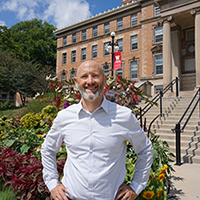
Revel Sims, Associate Professor, Department of Planning and Landscape Architecture
Professor Revel Sims incorporates mixed-methods action research in the field of housing and community development into his courses. This work is often based on collaborative research oriented around critical urban questions such as demonstrating the link between gentrification and displacement or forms of housing exploitation.
What do you do? Through my collaboration with the Tenant Resource Center (TRC) we developed a research plan and engaged a special graduate class to clean, quantify, and map evictions in Dane County at the neighborhood level. The resulting report influenced public discourse by revealing the connection between race and housing insecurity in the city. More recently, my collaboration with TRC has moved into questions of Latinx/e housing specifically. After initial conversations about concerns and objectives, I mobilized a special topics course in the Chicanx/e and Latinx/e Studies Program and employed TRC’s rich in-take data to collaboratively develop a research protocol and instrument that students in my class used to interview Spanish-speaking renters in Dane County. Through a qualitative analysis of the data, we found that despite institutional exclusion and a hesitancy to reach out that are often elevated in the literature, Latinx/e renters often seek the support they need to resolve their housing issues but face specific challenges in the housing market that make negotiating housing concerns and activating housing choice a less effective or available strategy.
Why do you do it? I came to academia from the field of education and work with community organizations. I believe that academic research plays an important role in shaping public discourse and policy formation. My training in the Community Scholars program at UCLA and the institutional support for the Wisconsin Idea here at UW–Madison have shown me that there is a long tradition of engaged scholarship that embraces the normative positions I hold. From this basis I seek to build relationships with likeminded organizations that uplift justice and challenge inequality in the field in of housing. Toward this end I bring my shared interests with community partners into the classroom through the creation of curricula that ground the work of community-based learning and engaged scholarship to facilitate the production of collaborative research projects.
What impact does it have on students? I believe the impact on students is twofold. First, in applied, service- or community-based learning projects with community partners, students learn beyond the classroom in terms of both the subject matter as well as the important roles that relationships and values play in grassroots efforts. The latter are especially challenging to assimilate because they are not easily comprehended through the certainty and uncomplicated structure of classroom settings that have a definite beginning and end. Second, I feel that most of the students in my classes are generally altruistic at heart. Working toward something “bigger” that “matters” helps to nourish the desire to make education meaningful.
What might you change in the future? In the contemporary context, there is an almost ubiquitous emphasis on technological solutions to urban problems. Smart cities will magically solve congestion; green infrastructure will incrementally make our planet more livable; digitized connections will usher in a more democratic polis. My reading of urban history tells me that this attention is fundamentally misguided. Thus, I believe that universities need to give more attention to engaging with the pressing social and spatial injustices that make the transformations underfoot real and lived. Addressing these concerns is not achievable through well-defined research questions, easily available data and positivist methods alone, but involves a normative orientation toward opening the university to new actors and extending its vast resources outward to serve the needs of those who experience injustice of urban change.
Guiding Questions
- What goals does the community partner have for the collaboration? How might you ensure the course provides students sufficient structure to meaningfully meet those goals?
- What feedback loops can you have with the community partner to understand how the project is progressing and the partner’s overall experience with the course?
- How might the course provide opportunities for students to learn relationship skills that can apply to their work with the partner and/or the community?
2. Incorporate Reflection
Reflection can help make learning personally relevant to students and foster deeper positive engagement with the community. Reflection can be used as part of preparation for students to engage with a community by helping students articulate their motivations for engagement and understand their own social identity and positionality (Tryon, Madden, & Sprinkel, 2023). Reflection can also aid student learning throughout a partnership. Regular reflection has been shown to increase student ownership of their learning, personal growth, greater understanding of skills gained, and connection to course content (Schober & Lujan, 2018). Reflections can also help students apply course content in multiple ways, such as to explore a theory in depth, to better understand practice, to inform decision-making, and to develop their own positions (García-Romero & Martínez-Lozano, 2022).
An acronym that can help instructors develop reflection questions and activities is RICO: Relevant to the student and/or world, Intrinsic to the student’s own self and values, Critical of power systems and societal impacts, and Outcome oriented toward applying what the student learned beyond the classroom (Tryon, Madden, & Sprinkel, 2023). Students may be hesitant to share personally through reflection. An effective practice to encourage deep and honest reflection is incorporating weekly journal reflections that are evaluated for completion along with two or three journal assignments over the course of a semester that are graded for content (Morgridge Center for Public Service, n.d.).
L&S Instructor Example: Fostering Authenticity and Generosity through Reflection
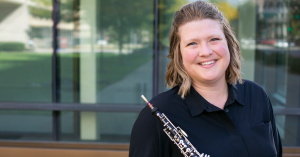
Lindsay Flowers, Assistant Professor of Oboe, Mead Witter School of Music
Professor Lindsay Flowers connects with multiple community partners and organizations in the music education and youth engagement space to determine projects and partnerships that students can plug into as part of the course. Partners have included Gigi’s Playhouse, Middleton Community Orchestra, Gilda’s Club, Stoughton Resettlement Project, Odyssey Project: Junior Music, OutReach LGBTQ+ Community Center, Renaissance Senior Living, Monona Public Library, and the Henry Vilas Zoo.
What do you do? Effective reflection requires one to be vulnerable. Each semester, the first task at hand is to break through everyone’s ego barrier (myself included)! How do we do this? While every semester is unique due to the student personnel in the course, we begin with mini-presentations where each student shares an example of an artist (it doesn’t even need to be a musician) whose collaborative work elevates a cause. Leading with a reflective assignment that celebrates the work that someone else is doing is a gateway for someone to share something that they care about and practice assessing the effectiveness of the partnership. Then when we reflect upon our own work, I remind my students to remember this first assignment when their reflection both celebrated and critiqued the work that someone else was doing.
Why do you do it? I have found that when one’s ego fades, one can lead with generosity, which I consider to be true confidence. At Mead Witter School of Music, I work with my students on developing authenticity and confidence in their creative work, oftentimes that is in the area of Music Performance. Then when they are in Music 608: Music Community Engagement, they experience bringing their authentic, vulnerable, and generous selves into their collaborations with community partners, Madison-based social services agencies. The students select a non-profit organization that they admire and find a connecting point to create a program or event that can use music as a tool to elevate the cause.
What impact does it have on students? My students repeatedly write in their reflective journals that their artistic passion is freshly fueled after experiencing their artistry making meaningful and measurable impacts with a community who does not typically or who are unable to attend their traditional music concerts. This conclusion is never reached with ease of success, but through commitment, communication challenges, dealing with perfectionism, and learning to adapt one’s project vision. Other small group reflective conversations have revealed that being able to perform in these moments has led to learning how to overcome one’s performance anxiety from the practice of performing with generosity over ego.
What might you change in the future? I want the students to more quickly identify who their community partners will be so that they can have more time working steadily together throughout the whole semester.
Guiding Questions
- How might you demonstrate the intellectual value of reflection and ensure students do not treat it simply as busy work?
- What varied reflection formats could you provide to students (e.g., in-class discussions, journal entries, reflection papers)?
- Do your students have a clear understanding of how to reflect? How can you prompt students toward more sincere, critical reflection?
3. Prepare Students for Community Engagement
Certain steps and considerations are important for preparing students for community work. Community work is less predictable than in a traditional classroom and might involve unexpected changes in personnel, timelines, resources, or goals. This freedom and uncertainty can pose a challenge for students. Instructors can foster adaptability and flexibility in students, while providing structures that ensure students are on a successful path that will still provide the partner with a useful outcome. It is helpful to acquaint students in advance with how their work may differ from other courses. For example, instructors can request a Community Engagement Preparation Workshop for students led by a Morgridge Center specialist, or incorporate Student Preparation Online Modules into their course. In addition, instructors may incorporate learning opportunities early on for communication, such as practice sessions for writing emails or speaking on the phone (Tryon, Madden, & Sprinkel, 2023).
In addition, an instructor can help students manage time and respond to project changes throughout the semester. For example, an instructor might provide class time for students to map out their calendar, or an instructor could create checkpoints throughout the semester at which students must submit certain materials or evidence of progress (Tryon, Madden, & Sprinkel, 2023). Supporting students during an unanticipated change might mean validating that a departure from the original expectations is not a failure and providing opportunities for students to reset goals and create a transition plan for future work (Tryon, Madden, & Sprinkel, 2023).
L&S Instructor Example: Persuasive Campaign Messages: Extending Classroom Boundaries to the State of Wisconsin
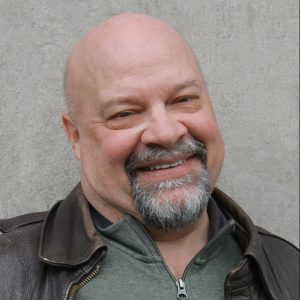
Douglas McLeod, Evjue Centennial Professor of Journalism and Mass Communication, School of Journalism and Mass Communication
Professor Doug McLeod teaches a Creative Campaign Messages course for the School of Journalism and Mass Communication at the UW–Madison. In this course, students partner with UniverCity Alliance to provide opportunities and work in teams to create a strategic communication plan including an integrated set of print, broadcast, and social media messages to help towns and counties in the state of Wisconsin to achieve organizational goals.
What do you do? All of the students in J445: Creative Campaign Messages are SJMC majors, which means they have already had a series of strategic communication skills courses to prepare them for the project-based learning experience in J445. They have had J202 (a professional writing boot camp course), J203 (an applied research course), and J345 (a project-based strategic course, all of which train students in the skills that they use in J445. Once they get into J445, we engage in a project in which students research a consumer brand and create a portfolio of messages to promote this brand. Sometimes, we also have an additional project creating campaign messages for a local client. So, by the middle of the semester, students have been trained on research, strategy and creative messaging such that they have already experienced the process that they will use for the UniverCity Alliance project.
Why do you do it? One of the most important reasons for our participation in this community-based, service learning project, is to provide my students with opportunities to apply the strategic communication skills that they are learning in class by engaging with real-world clients. Working with community organizations from around the state takes students outside their comfort zone of everyday experiences and encourages them to think outside the box. With the support of the Morgridge Center, my students are able to travel to meet with clients in communities around Wisconsin. Following the spirit of the Wisconsin Idea, my students bring the knowledge and skills they are developing in our classrooms to assist the people and organizations of the state of Wisconsin.
What impact does it have on students? The students get to apply the knowledge and sharpen their skills through the “learn-by-doing” approach of project-based learning. Not only do these experiences prepare students for jobs in strategic communication, but they also develop an appreciation of local government programs and the benefits of public service. The immediate reaction of UniverCity Alliance project clients has been very positive. Some of them have contacted me after the course is complete with follow up questions and/or to inquire about student interest in continuing with them.
What might you change in the future? I am constantly working to innovate new assignments and activities into my project-based learning courses. Many of these changes are driven by the constant evolution of research techniques and media technologies such as social media.
Read more about the Creative Campaign Messages course in this SJMC article!
Guiding Questions
- How might you structure your course to provide students opportunities to understand the community that is being worked with, as well as relevant content and history related to the community or issue?
- How might you make explicit the professional skills surrounding the community engagement, such as professional communication, collaboration, and technical skills?
- What role does the community partner have in the course? How might you provide them opportunities to suggest readings, present about their work, or otherwise orient students to the project?
Opportunities for the Future
Pluralism in Practice
Recent efforts on campus, through the Wisconsin Exchange, have emphasized the value of the robust exchange of ideas, although often these exchanges are limited to campus settings. Community-Based Learning offers a unique opportunity to explore pluralism by allowing students to consider and engage with an even wider array of perspectives. Well-structured CBL courses already deepen students’ civic development through exposure to various community-engaged settings and projects, as well as engagement with nonprofit or public sector professionals and the general public. Nicholas Longo, Director of Rutgers’ Democracy Lab, argues that these courses can go further. Through deliberative pedagogies that combine deliberative dialogue, democratic education, and community engagement, instructors can move beyond civic learning as a theoretical exercise and engage students in nonpartisan, real-world civic action (2013).

Connect with the Morgridge Center for Public Service
The mission of the Morgridge Center is to connect campus and community through community-based service, learning, and research to build a thriving democratic society. Our staff are available for consultations to support your development of community-based teaching or research projects. We can help at any stage, from scoping possible partners, refining a community-engaged course assignment, to implementing a new course. Reach out to request a meeting.
Connect with the L&S Instructional Design Collaborative
Would you like help getting started on making a change to an assignment? Do you want to discuss your ideas? Our team is happy to meet with you, brainstorm solutions that meet your needs, and help implement your ideas. Our work typically starts with one 45-minute virtual meeting. To get started, request a meeting.
Suggest a Topic or Colleague
We want to hear your ideas! What teaching topic or trend would you like to know more about? Which of your colleagues are doing great work in the classroom? Share your ideas for our next article in the Design for Learning Series.
Fisher, E. E., Sharp, R. L., & Bradley, M. J. (2017). Perceived benefits of service learning: A comparison of collegiate recreation concentrations. Journal of Experiential Education, 40 (2), 187–201. https://doi.org/10.1177/1053825917700922
García-Romero, D. & Martínez-Lozano, V. (2022). Social participation and theoretical content: Appropriation of curricular concepts in service-learning. Journal of Higher Education Outreach and Engagement 26(1), 71-87.
Hou, S. I. (2010). Developing a faculty inventory measuring perceived service-learning benefits and barriers. Michigan Journal of Community Service Learning, 16(2), 78-89.
Karasik, R. J. & Hafner, E. S. (2021). Community Partners’ Satisfaction with Community-Based Learning Collaborations. Journal of Community Engagement and Scholarship 14(1). https://doi.org/10.54656/DDVW5450
Longo, N. V. (2013). Deliberative pedagogy in the community: Connecting deliberative dialogue, community engagement, and democratic education. Journal of Deliberative Democracy, 9(2).
Mauro, E., Manià, K., Ubels, N., Holroyd, H., Towle, A., & Murray, S. (2024). Reciprocity in community-engaged learning: A case study of an undergraduate knowledge exchange project in an over-researched urban community. Michigan Journal of Community Service Learning 30(1). https://doi.org/10.3998/mjcsl.3795
Maxwell, A., Yates, J., Pfingstgraef, K., & Mantler, T. (2025). Undergraduate students’ experiences of a community-engaged learning course: A mixed-methods study. Journal of Experiential Education, 10538259241309640.
Morgridge Center for Public Service. (n.d.). Community-based learning: Course development resource guide. https://morgridge.wisc.edu/wp-content/uploads/sites/4/2023/11/CBL-Resource-Guide.pdf
Otto, E., & Dunens, E. (2024). Imparting the skills employers seek: Community-engaged learning as career preparation. Journal of Community Engagement and Higher Education, 13(1), 4.
Schober, G. S. & Lujan, J. M. (2018). A Standardized service-learning structure: A model for partnering with multiple community organizations in a single course. In Núñez, G. M. & Gonzalez, A. L. (Eds.), Community engagement and high impact practices in higher education (pp. 157-167). Kendall Hunt.
Strage, A. A. (2000). Service learning: Enhancing student learning outcomes in a college-level lecture course. Michigan Journal of Community Service Learning, 7, 5-13.
Tryon, E. A., Madden, H. C., & Sprinkel, C. (2023). Preparing Students to Engage in Equitable Community Partnerships: A Handbook. Temple.
This work is licensed under a Creative Commons Attribution-NonCommercial-NoDerivatives 4.0 International License. This means that you are welcome to share this content in its original form, but we ask that you provide attribution to the L&S Instructional Design Collaborative, link to this original source for context, and not use the material for commercial purposes.
Example attribution: From Engage Students in Community-Based Learning by the Morgridge Center for Public Service and the L&S Instructional Design Collaborative, licensed under the BY-NC 4.0 license.