Theme 2: Supporting Student Connections
Helping students make personal connections in the classroom with instructors, peers, and disciplinary content can support students feeling like they belong. When learners develop a sense that they belong, they are better able to participate, sustain attention and motivation, and retain knowledge. This page offers strategies from research literature and our L&S colleagues that support students and instructors in developing these connections.
Pick one Mini Discussion below and include a 10-15 minute conversation in your next group meeting.
Mini Discussions in this Theme

Short discussions focused on teaching and learning can be a great way to start a team or department meeting by:
- Getting everyone’s voice into the room
- Creating shared time for talking about teaching and learning
- Easing attendees into thinking about a topic in a low-stakes way
- Pick one Mini Discussion below that’s relevant for your group.
- Schedule 15 minutes for conversation in your next group meeting.
- During your meeting, spend 10 minutes in small group or pair discussion. Spend 5 minutes sharing out with the larger group.
Our staff provide facilitation tips based on your group’s goals and members, or we can join your meeting to facilitate a Mini Discussion. Fill our our request form to get help facilitating.
2.1 Normalize Learning and Using Others’ Names
If you could do one thing to make a difference in students’ learning, use their name. You could do that with photographs, and now we have these great photo rosters. But I find when I meet students in their sophomore year, they look nothing like the photographs that they took in their freshman year.
So I ask students to get together in a group and take a selfie of their group, and so I can ask them to make a name card, put their name in bold, and take a picture. And I learn students’ names in groups, typically. That’s one of my tricks.
I often cue them when they’re talking to one another to introduce themselves. It’s kind of awkward when you’ve sat across from somebody for weeks and weeks and you still don’t know their name. So I am the one that’s always breaking the ice and saying, remember to introduce yourself.
Discussion Questions
- What strategies do you use to learn student names?
- How might you help students learn and use each other’s names?
- Think of the last time someone addressed you by name. How did this make you feel?
2.2 Get to Know Your Students
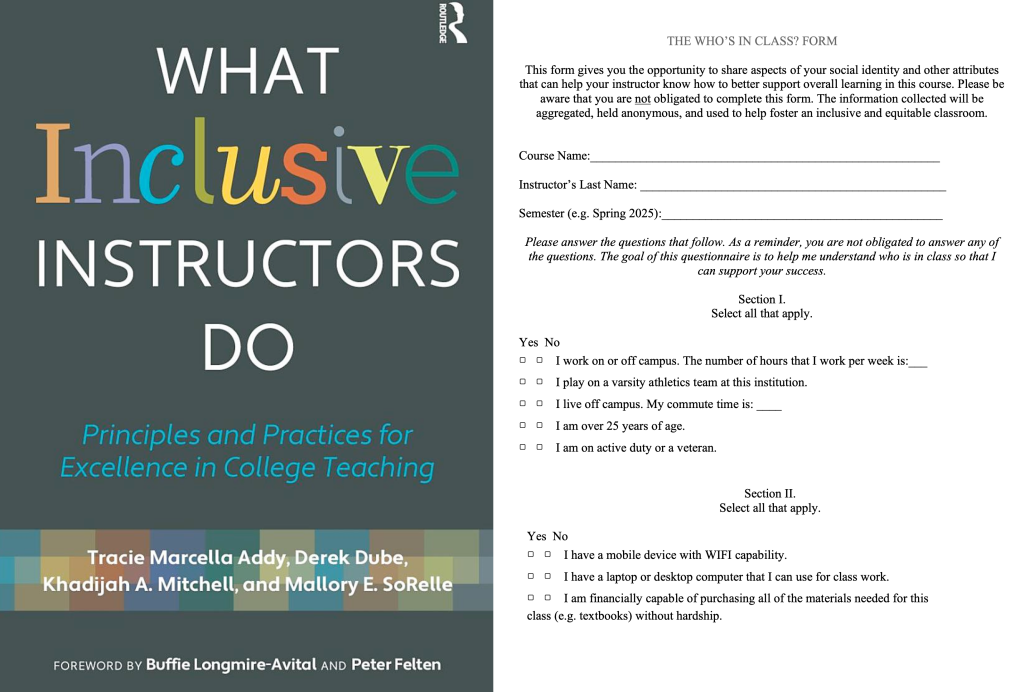
Tracie Addy’s “Who’s in Class?” Survey is designed to help instructors understand student commitments beyond academics, technology access, financial barriers, health concerns, prior experiences, and more. Instructors who used the survey report that having more information about students helped them make small improvements in their course.
Instructors tried new strategies in their courses to foster inclusion. Examples included meeting informally with students one-on-one as well as weekly with groups, incorporating more flexibility in assignment deadlines, providing alternative virtual spaces for students to ask questions, and creating classroom guidelines for discussions.
Discussion Questions
- What do you already know about your students?
- What’s one question you will ask your students to get to know them better at the start of the semester?
- How might their responses to this question inform your decisions and teaching strategies?
2.3 Encourage Interdependent Group Work
Gil Moreu and UW–Madison Psychology Professor Markus Brauer synthesize educational research to identify twenty easily implementable inclusive practices for college instructors. They find that setting up group work so that group members are interdependent on one another can reduce prejudice, increase student satisfaction with group work, and improve student performance.
Instructors can achieve such interdependence in a variety of ways. They can provide group members with different pieces of information so that the group can complete the task only if the members successfully pool the information (a key idea in the so-called “jigsaw classroom”; Nolan et al., 2018). Instructors can randomly choose the student who reports the group work afterwards, rather than letting the group choose its speaker. Finally, they can assign one grade to the entire group, either for the task at hand or for the entire course if the group composition was the same throughout the semester.
Discussion Questions
- Do you ask students to work together? Why or why not?
- How might you encourage more interdependence in your course?
- How might you communicate the relevance of group work to students?
2.4 Plan Space for Student Contributions
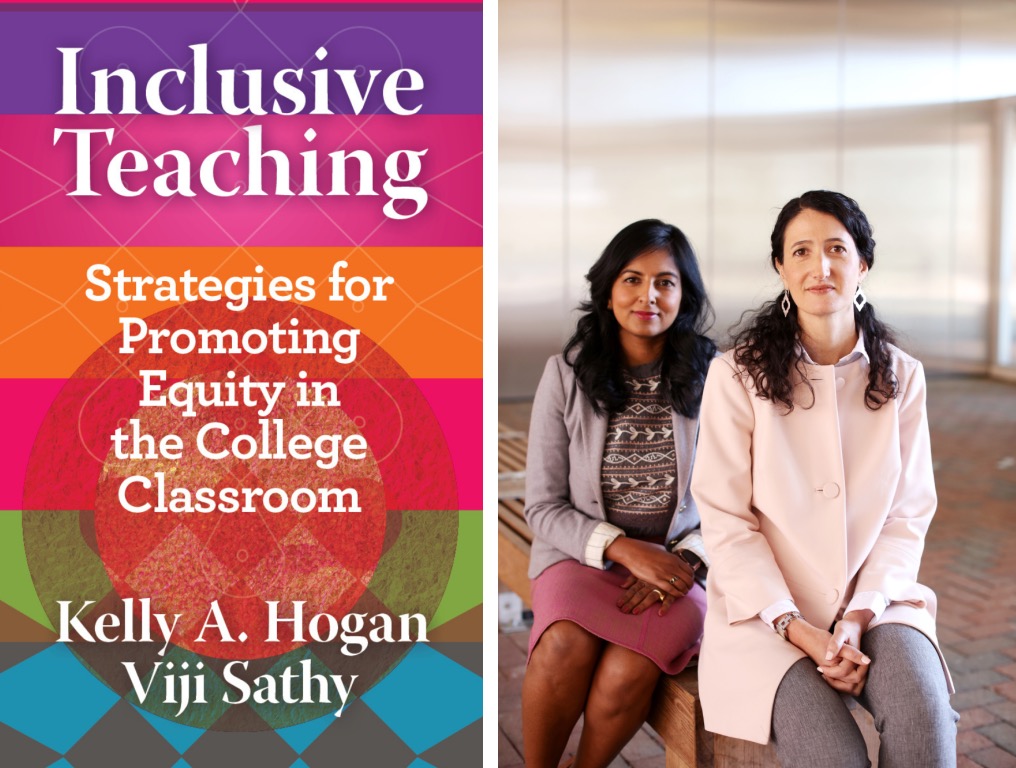
From pg. 120 of Hogan, K. A., & Sathy, V. (2022). Inclusive Teaching: Strategies for Promoting Equity in the College Classroom. West Virginia University Press.
The table below presents two classroom scenarios along with possible additions that can create a more inclusive environment for student interaction and contributions.
| Scenarios | More Inclusive Additions |
| The instructor wings it: They walk into class session with 3 broad questions for students to work through. | The instructor shares 3 questions with students in advance, and has a plan for the method they will use in class (think-pair-share or small groups with assigned roles). |
| The instructor sets no rules and students are free to contribute or not. | The instructor sets or co-designs rules of engagement with the class. Students know how they will be evaluated and what happens if they break the rules. |
Discussion Questions
- Imagine yourself as a student. What makes these scenarios more or less appealing?
- What’s one change you can make to create more space for student contributions?
2.5 Diversify Examples and Perspectives
Gil Moreu and UW–Madison Psychology Professor Markus Brauer synthesize educational research to identify twenty easily implementable inclusive practices for college instructors. They find that the authors of readings you assign, the important figures in your field, and the examples you use in class identify potential role models for students. Helping students connect with these role models can increase a sense of belonging in your classroom, and including photos of these role models can be especially helpful when it allows students to find commonalities with their own identities.
An easily implementable way of expanding students’ role model pool is to display pictures of the scientists who conducted the research when presenting the results of empirical research in class. However, since many fields are dominated by White cisgender able-bodied men, it is critical that instructors work to decolonize and to diversify their course content before being able to show photos of the associated researchers. Many students benefit from the increased pool of potential role models, but women and members of marginalized groups are most likely to benefit— especially when the researchers on the pictures are also women or members of a marginalized group.
Discussion Questions
- What perspectives and identities are dominant and marginalized in your area of study? Are these represented in your course?
- Where are there opportunities to introduce more perspectives?