Supporting Teaching, Learning, and Technology in the College of Letters and Science
Classroom Strategies with Top Hat
Top Hat is primarily used as our campus-supported audience response system, which can be particularly helpful in large-enrollment courses. It can help instructors surface misunderstandings, gather questions and feedback, prompt discussion between students, and more.
Warm Up as Class Begins
Use the 4 strategies below to bring everyone’s ideas into the classroom and help students begin to focus on the upcoming course activities and content.
|
Goals:
Everyone contributes.
Students begin thinking about the course or lecture topic by reflecting on two options in a low-stakes way.
Example Prompts:
Prompt
Question Type in Top Hat
Lake Sturgeon or Brook Trout?
Multiple choice question
The Yellow Wallpaper or The Tell-Tale Heart?
Multiple choice question
Example prompts matched to question types in Top Hat
Screenshot in Top Hat:
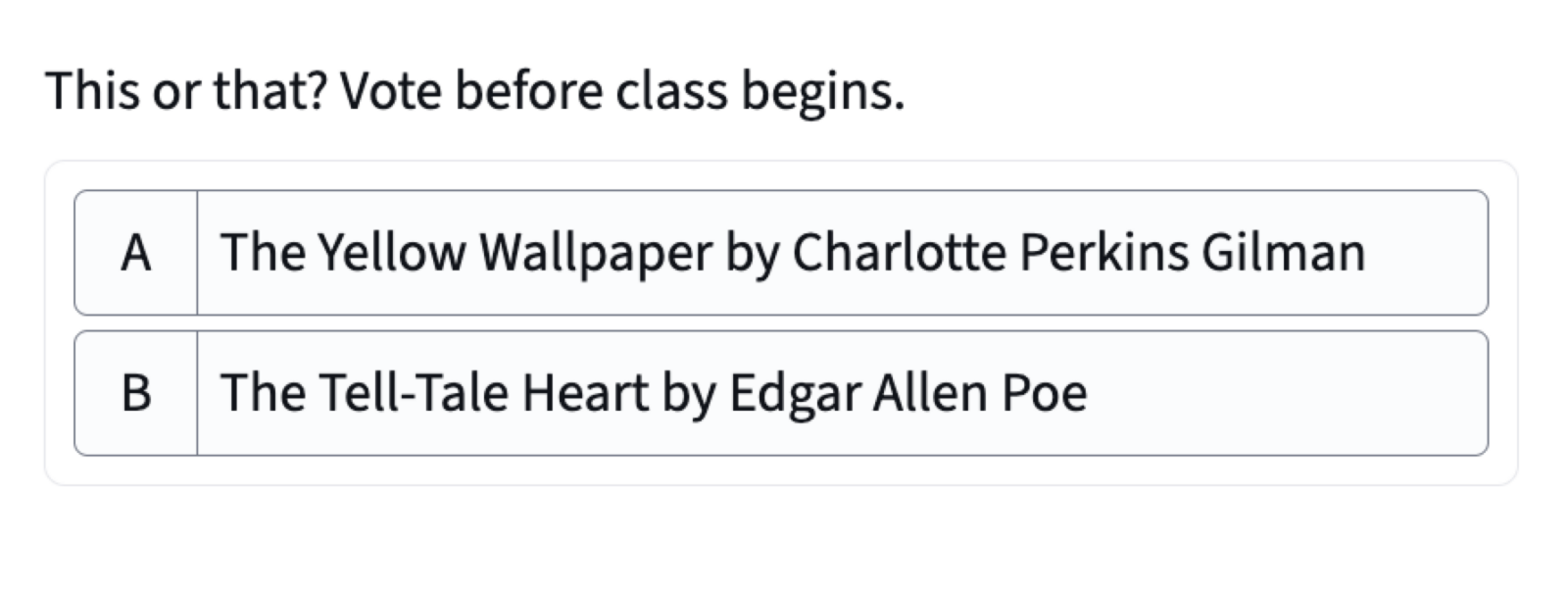
Top Hat multiple choice question without a correct answer that prompts students to choose between The Yellow Wallpaper by Charlotte Perkins Gilman or The Tell-Tale Heart by Edgar Allen Poe.
Facilitation Tips:
“This or that?” style questions are a low-stakes and open poll about preferences where there is no correct answer. Choosing can draw students into answering, “Why?” and students get to decide the criteria.
Display this question and the tally of student votes as students enter the classroom. This can prompt natural conversations between students about the choices before class begins. To allow students to continue voting while you display results, you must change an Advanced course setting in Top Hat. See the steps under Allowing Real-Time Changes from Top Hat Support.
When class begins, ask for someone who chose each option to share the reasoning for their choice. Students sharing their reasoning can help the class connect with each other, help you better understand student perspectives, and provide information you can connect to course concepts and objectives.
Goals:
Every student contributes.
Students see and appreciate the existing knowledge and experience in the classroom.
Students begin thinking about topics related to the course ahead.
Example Prompts:
Prompt
Question Type in Top Hat
What’s one thing you already know about ancient Rome?
Word answer question or Discussion
Which major historical events happened in Rome?
Multiple choice
How much experience do you have with translating Latin?
Likert scale or Multiple choice
Example prompts matched to question types in Top Hat
Example in Top Hat:
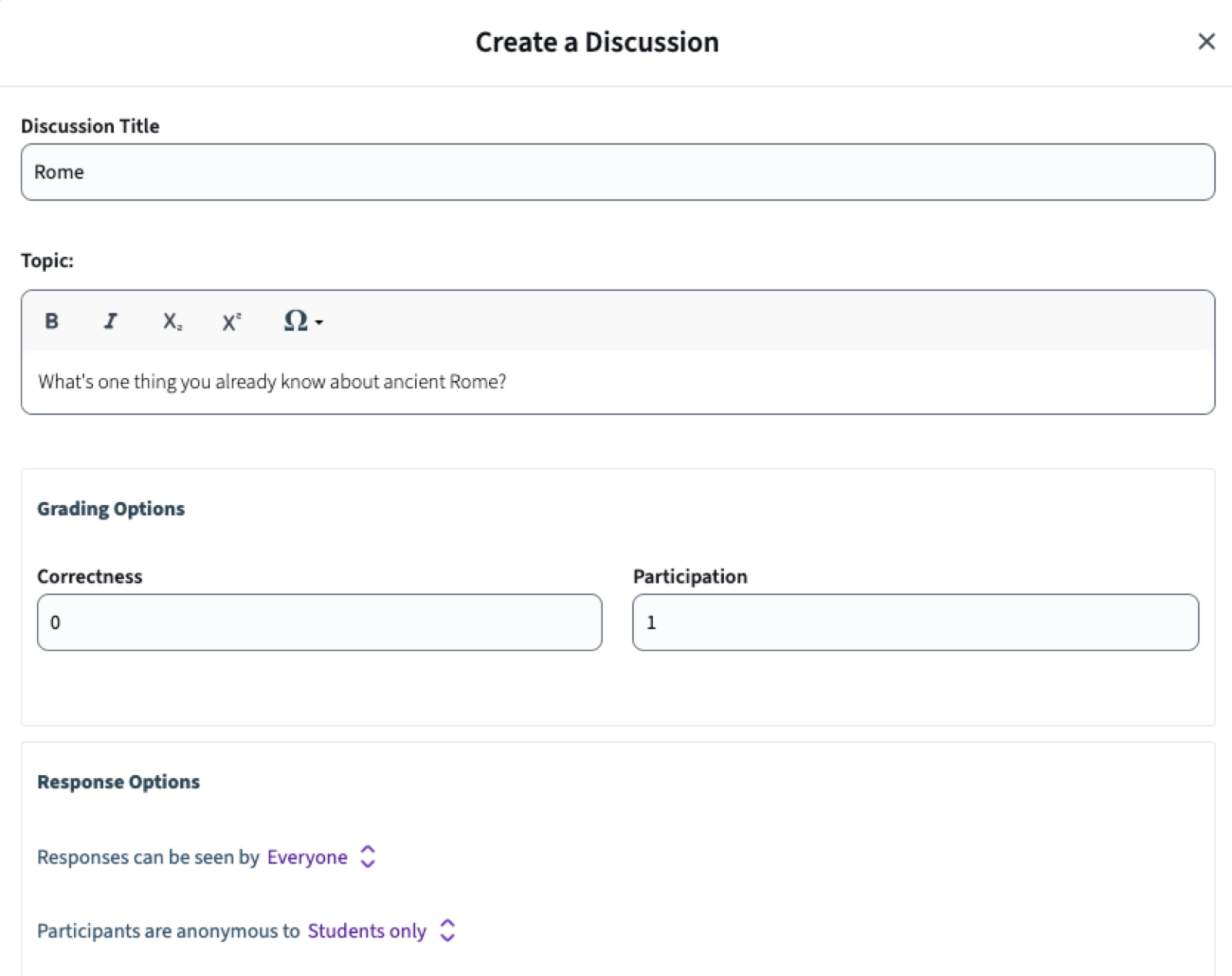
Top Hat discussion question that doesn’t have a correct answer, with Response Options so that all students and instructors can see all responses, and responses appear anonymously to students. This Discussion asks, “What’s one thing you already know about ancient Rome?”
Facilitation Tips:
Students will be able to see all responses on their device, and student contributions can be anonymous if you select this setting under “Response Options” when you create the question in Top Hat.
Verbally highlight several responses to validate students’ prior knowledge and experiences, and correct misconceptions as needed.
Closed-ended questions (Multiple Choice, True/False, Fill in the Blank, or Likert scale questions) can work well with larger class sizes.
Open-ended questions (Word Answer question or Discussion) can work well with smaller class sizes.
Goals:
Everyone contributes.
Student contributions are seen by each other and the instructor.
Students begin thinking about the course by reflecting on their experience with course materials or topics.
Example Prompts:
Prompt
Question Type in Top Hat
In one word, define the theme of today’s reading (“Democracy versus Republic” by Danielle Allen).
Word answer
In one word, describe the tone of Jill Lepore’s 99% Invisible episode.
Word answer
In one word, describe your reaction to Danielle Allen’s keynote speech from the Diversity Forum.
Word answer
Example prompts matched to question types in Top Hat
Screenshot in Top Hat:
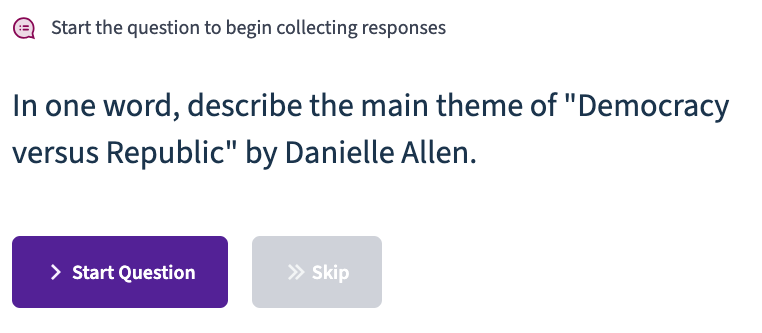
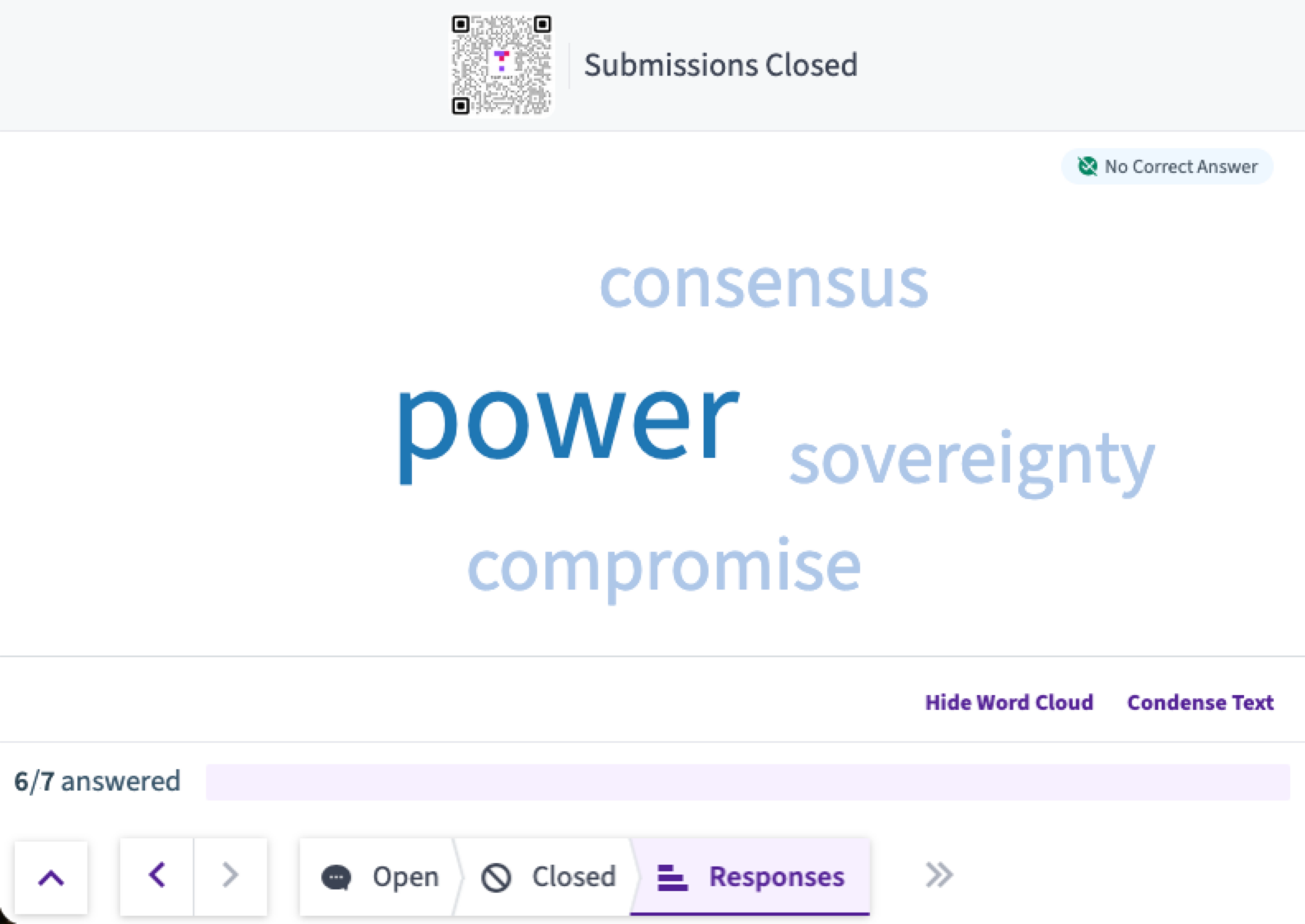
Top Hat word answer question without a correct answer that prompts students, “In one word, describe the main theme of ‘Democracy versus Republic’ by Danielle Allen.”Student responses to a word answer question can be displayed as a word cloud.
Facilitation Tips:
When you use a Word answer question, you can display student responses as a word cloud. “Show Word Cloud” is an option on the “Responses” pane once students have answered. Word clouds work best when instructors solicit one word instead of phrases or sentences.
Consider asking students to discuss results in pairs. What do they notice about the word cloud? Is this consensus similar to or different from what they think? What do they find most compelling and why?
Verbally highlight a few commonalities (larger words in the word cloud) and a few less common submissions (smaller words in the word cloud).
Goals:
Everyone contributes.
Student contributions are seen by each other and the instructor.
Students help each other recall past learning in order to connect it to today’s learning.
Example Prompts:
Prompt
Question Type in Top Hat
What are two things you remember about social determinants of health?
Word answer or Discussion
Based on last week’s lecture, which of the following are considered social determinants of health?
Multiple choice (lower-order thinking)
Last week we considered social determinants of health. How does living in a higher crime area impact health?
Multiple choice (higher-order thinking)
Example prompts matched to question types in Top Hat
Screenshot in Top Hat:
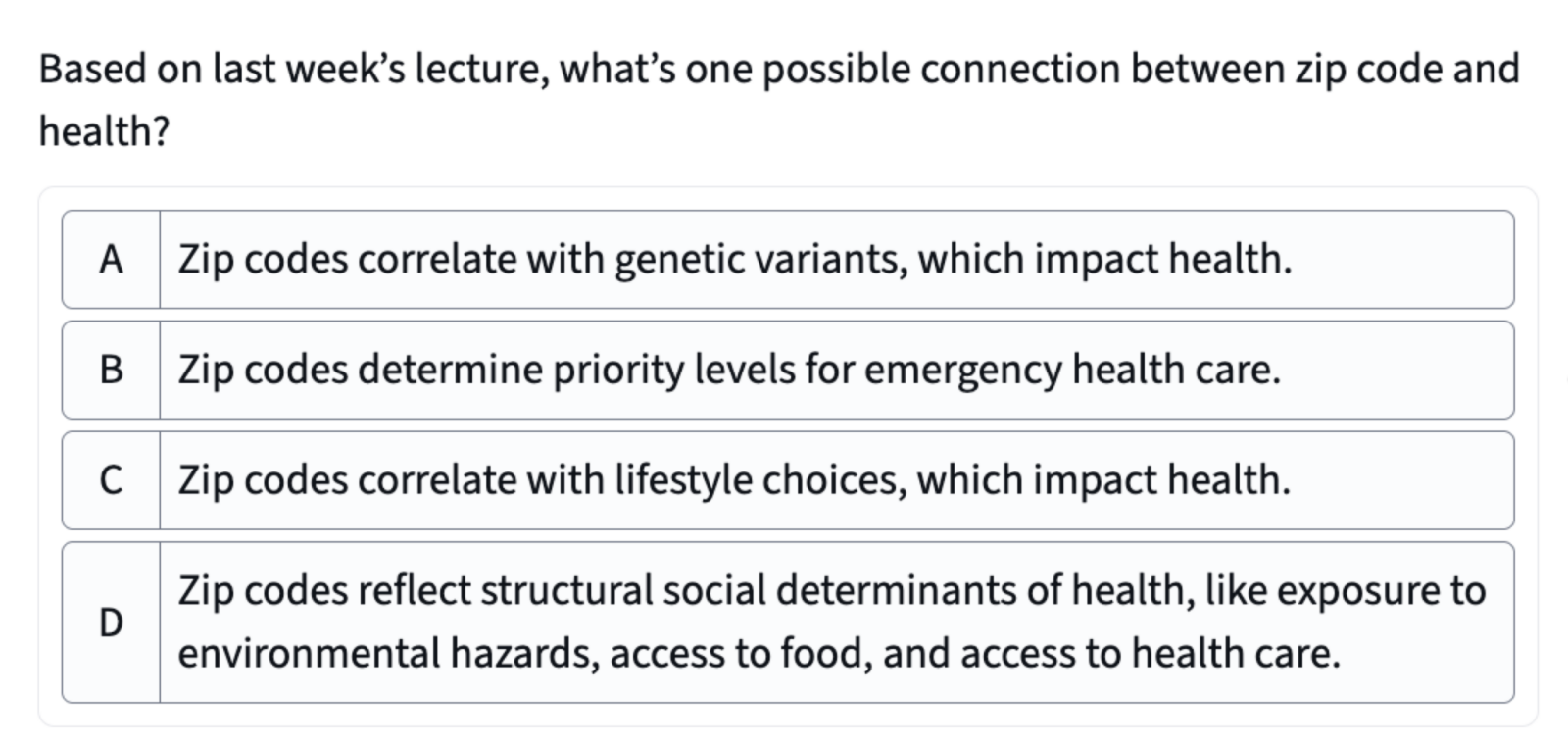
Top Hat multiple choice question with one a correct answer that asks, “Based on last week’s lecture, what’s one possible connection between zip code and health?”
Facilitation Tips:
Be prepared to ask for volunteers to explain and/or present supplemental learning material if students struggle to recall information.
Frame forgetting as a normal part of learning, and struggling to recall information as a productive part of learning.
Closed-ended questions (Multiple Choice, True/False, Fill in the Blank, or Likert scale questions) can work well with larger class sizes.
Open-ended questions (Word Answer question or Discussion) can work well with smaller class sizes.
Multiple choice questions can target higher-order thinking by asking students to make a hypothesis about a scenario.
Once students complete this recall activity, connect new concepts back to this prior learning.
Check Understanding During Class
Use the 4 strategies below to gauge how well students understand concepts to guide your teaching and class activities.
|
Goals:
Students check their own understanding.
Instructor gauges student progress and tailors class lecture / activities accordingly.
Example Prompts:
Prompt
Question Type in Top Hat
What term refers to the time, effort, and money an individual spends to gather information and locate a product in a market?
Multiple choice (lower-order thinking)
Imagine Alex is on a dating app and has set minimum criteria to accept a match. If the perceived effort of continuing to search increases significantly, how will Alex’s minimum criteria and search behavior adjust?
Multiple choice (higher-order thinking)
Example prompts matched to question types in Top Hat
Screenshot in Top Hat:
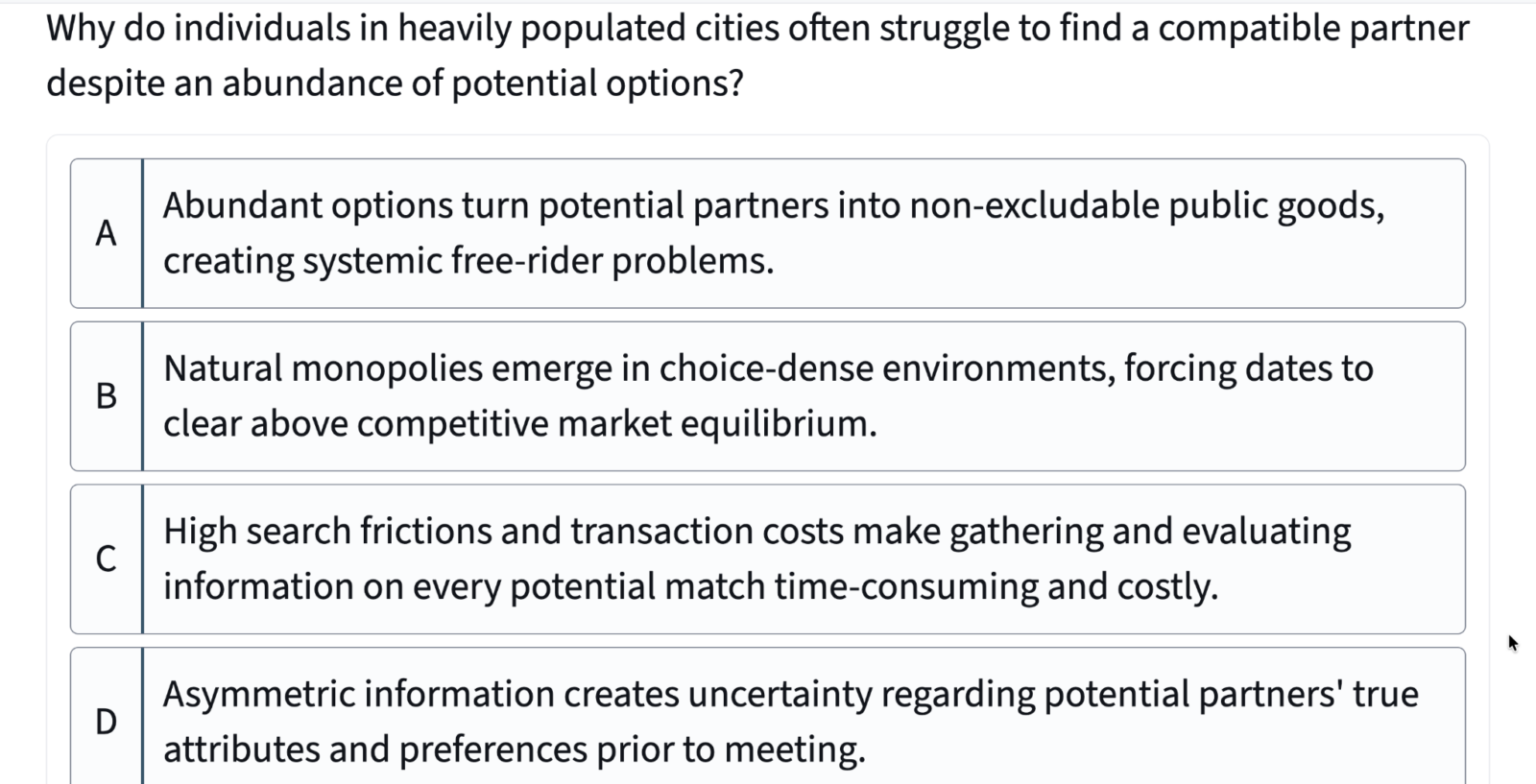
Top Hat multiple choice question with multiple correct answers that asks, “Why do individuals in heavily populated cities often struggle to find a compatible partner despite an abundance of potential options?”
Facilitation Tips:
Be prepared to present supplemental learning material if students struggle with the question. How else can you explain or demonstrate a tricky concept? Consider if a particular example or activity will help make the information more memorable, or if a student can accurately explain to others.
Closed-ended questions (Multiple Choice, True/False, Fill in the Blank, or Likert scale questions) can work well with larger class sizes.
Open-ended questions (Word Answer question or Discussion) can work well with smaller class sizes.
Multiple choice questions can target higher-order thinking by asking students to make a hypothesis about or evaluate a scenario.
Goal:
Reinforce immediate learning.
Reveal to students and instructors where students are struggling.
Example Prompts:
Prompt
Question Type in Top Hat
For a function, the set of all possible inputs is called the [blank] and the set of all possible outputs is called the [blank].
Fill in the blank
Which is the best definition of the range of a function?
Multiple choice (lower-order thinking)
Is the following solution correct? To find the slope of the line through points (2, 1) and (3, 4) We use the slope formula For these two points, we calculate the slope as
Multiple choice (higher-order thinking)
Example prompts matched to question types in Top Hat
Screenshot in Top Hat:
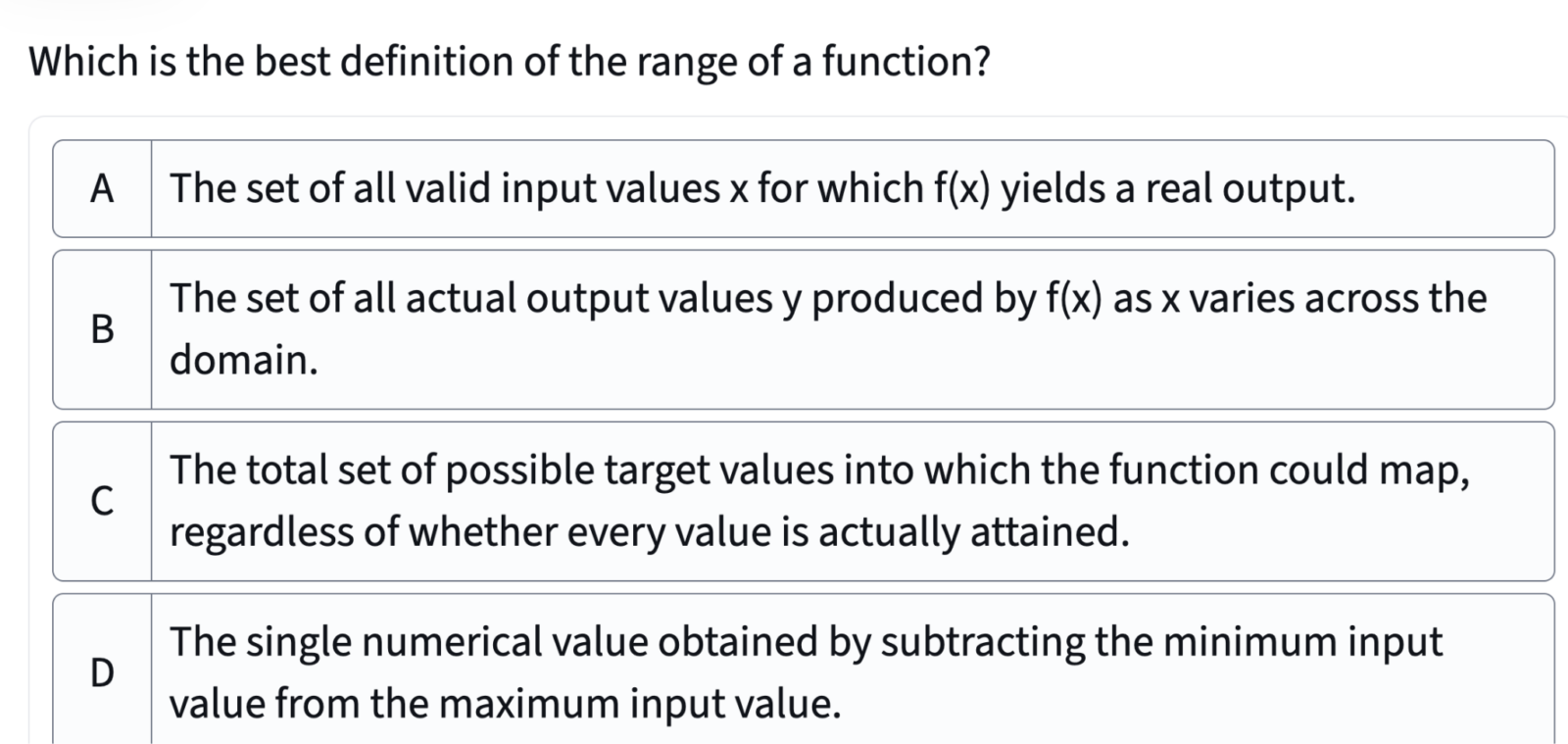
Top Hat multiple choice question with one correct answer that asks, “Which is the best definition of the range of a function?”
Facilitation Tips:
Be prepared to present supplemental learning material if students struggle with the question. How else can you explain or demonstrate a tricky concept? Consider if a particular example or activity will help make the information more memorable, or if a student can accurately explain to others.
Closed-ended questions (Multiple Choice, True/False, Fill in the Blank, or Likert scale questions) can work well with larger class sizes.
Open-ended questions (Word Answer question or Discussion) can work well with smaller class sizes.
Multiple choice questions can target higher-order thinking by asking students to make a hypothesis about or evaluate a scenario.
Goal:
Reinforce immediate learning.
Students help each other reach the correct answer and understand why the answer is correct.
Example Prompts:
Prompt
Question Type in Top Hat
A city enacts strict anti-price gouging laws during a natural disaster, freezing emergency supplies like bottled water at pre-disaster prices. Which trade-off best describes replacing price signals with price controls during a severe shortage?
Multiple choice
A business school allocates seats in oversubscribed elective courses by giving students a fixed budget of artificial points to bid in an auction, rather than using a first-come, first-served registration. What primary advantages does this points-based market offer?
Multiple answers
Example prompts matched to question types in Top Hat
Screenshots in Top Hat:
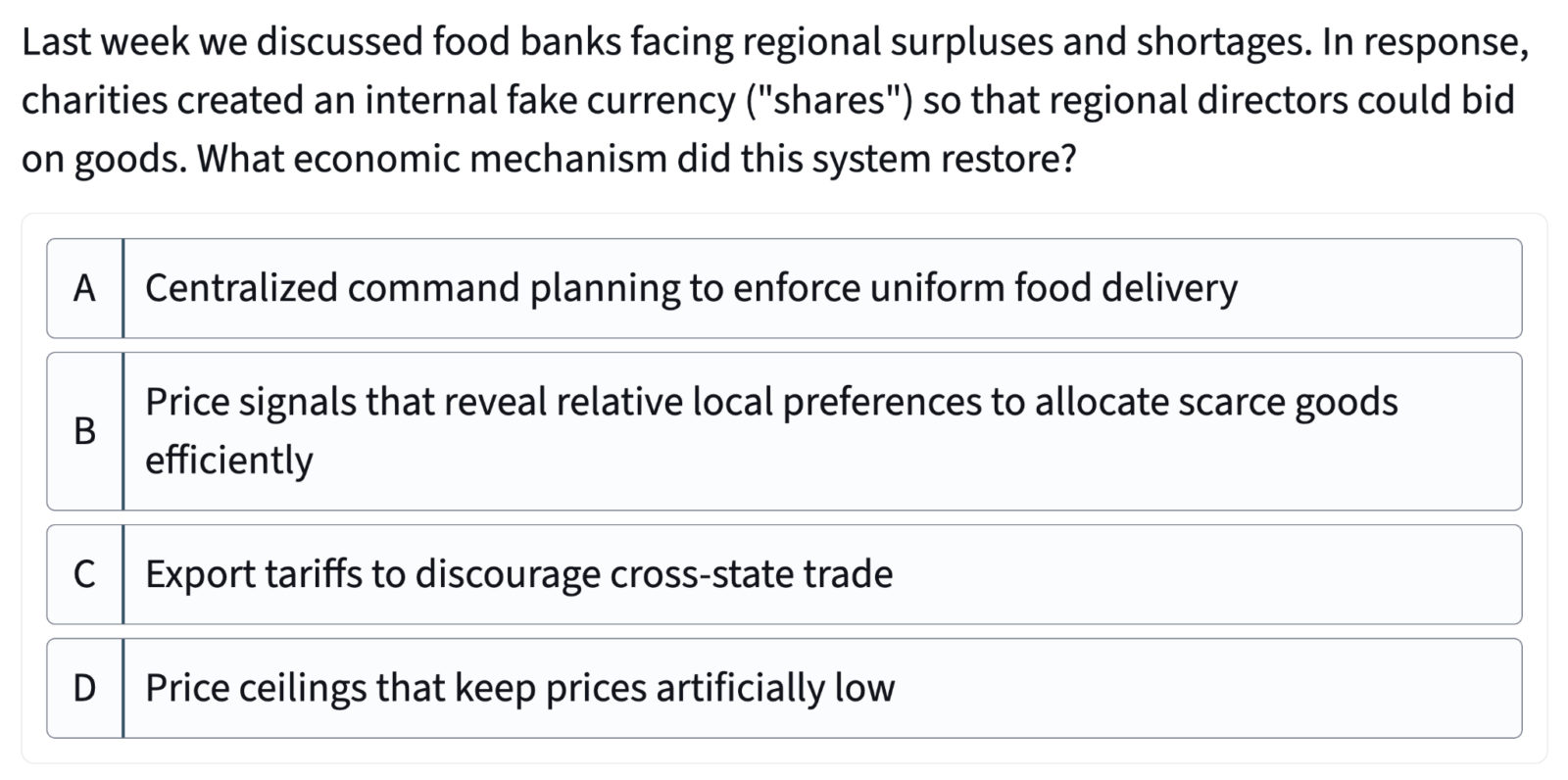
Top Hat multiple choice question with one a correct answer that asks, “Last week we discussed food banks facing regional surpluses and shortages. In response, charities created an internal fake currency (“shares”) so that regional directors could bid on goods. What economic mechanism did this system restore?”
Facilitation Tips:
Initially, ask students to respond to the question individually. Questions that ask students to remember a past concept, apply knowledge to a scenario, or use their judgement can prompt discussion.
Close the question to new responses. Then:
Either: Show the responses (how students’ answered in aggregate), but not the correct answer.
Consider giving students a hint if most people are incorrect initially – e.g., the most popular answer is not correct. Discuss!
Or: Show neither the responses (how students’ answered in aggregate) nor the correct answer.
This approach can be helpful if you don’t want students swayed by the most popular response.
Ask students to discuss their choice and their reasoning with a student nearby – e.g., How confident are you in your response? Is your partner’s choice and reasoning compelling? Has your thinking changed after talking it through?
Engage the larger class in a discussion around the reasoning for each possible response. Ask one student or pair to summarize each response.
Finally, re-open the question a second time and reveal the distribution of responses and the correct answer.
Instructor identifies misconceptions in order to provide supplemental instruction and/or clarifying examples.
Example Prompts:
Prompt
Question Type in Top Hat
Which statement best explains why cave-dwelling fish populations can lose their eyes over many generations?
Multiple choice
“Survival of the fittest” refers to the physically strongest or fastest organisms surviving.
True or false
Example prompts matched to question types in Top Hat
Screenshots in Top Hat:
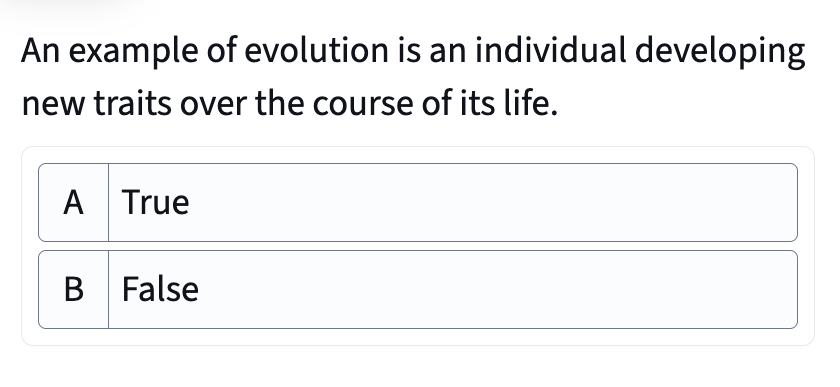
Top Hat true or false question with one a correct answer that says, “An example of evolution is an individual developing new traits over the course of its life.”
Facilitation Tips:
Focus on preconceptions students bring to class, or misconceptions students are likely to develop during the semester when developing these questions.
True/false and Multiple choice questions work well to clarify correct answers, and can lead to discussion when students are asked to explain answers to peers.
Create short supplemental explanations and clarifying examples to dispel misconceptions in response to the question and responses.
Variation: If most students fall for a misconception, consider having students discuss with people around them, and then answer the question a second time. If students need an extra nudge, consider showing the results (but not the correct answer) before students discuss and telling students the most popular response is not correct. Their discussion will then focus on the other options. See TopHat – Asking the same question twice for options on how to score multiple iterations of the same question.
Encourage Metacognition at the End of Class
Use the 3 strategies below to prompt students to think about what they do and don’t understand and how to improve their learning.
|
Goals:
Students recall their own learning.
Instructors surface possible gaps in student recall.
Example Prompts:
Prompt
Question Type in Top Hat
What is one important thing you remember from class today?
Word answer or Discussion
Without looking at your notes, write down everything you remember from today’s class.
Word answer or Discussion
Example prompts matched to question types in Top Hat
Screenshots in Top Hat:
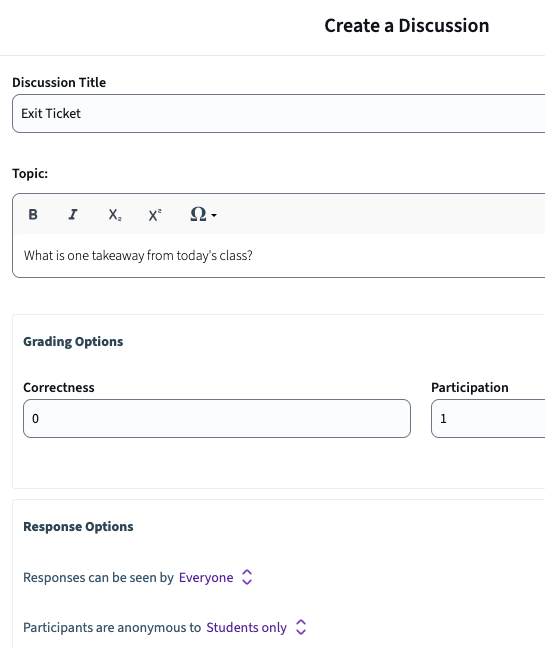
Top Hat discussion question that doesn’t have a correct answer, with Response Options so that all students and instructors can see all responses, and responses appear anonymously to students. This Discussion asks, “What is one takeaway from today’s class?”
Facilitation Tips:
At a high level, these responses can help you gauge if students are correctly identifying takeaways from class.
These questions are valuable even if you don’t review all student responses in detail. The act of effortful recall can help students remember concepts, and doesn’t require immediate corrective feedback when used with other feedback mechanisms, like quizzes.
Goals:
Students identify their own knowledge gaps.
Instructors surface questions to address in future classes.
Example Prompts:
Prompt
Question Type in Top Hat
Share one question you have from today’s lecture.
Word answer or Discussion
What concepts from this unit are unclear?
Word answer or Discussion
Example prompts matched to question types in Top Hat
Screenshots in Top Hat:
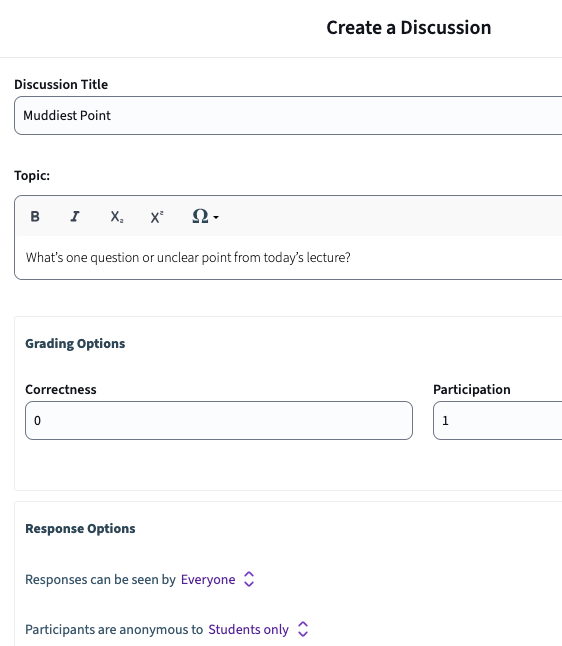
Top Hat discussion question that doesn’t have a correct answer, with Response Options so that all students and instructors can see all responses, and responses appear anonymously to students. This Discussion asks, “What’s one question or unclear point from today’s lecture?”
Facilitation Tips:
Use the questions students share in future classes (e.g., question of the day, discussion question, etc.) or post questions and corresponding information in Canvas to clarify common misunderstandings.
Goals:
Student reflect on their own learning process.
Students identify effective study or coursework strategies.
Example Prompts:
Prompt
Question Type in Top Hat
How do you study? Why? And does it work?
Word answer or Discussion
What strategies will you use to retain information from this unit?
Multiple choice
Example prompts matched to question types in Top Hat
Screenshot in Top Hat:
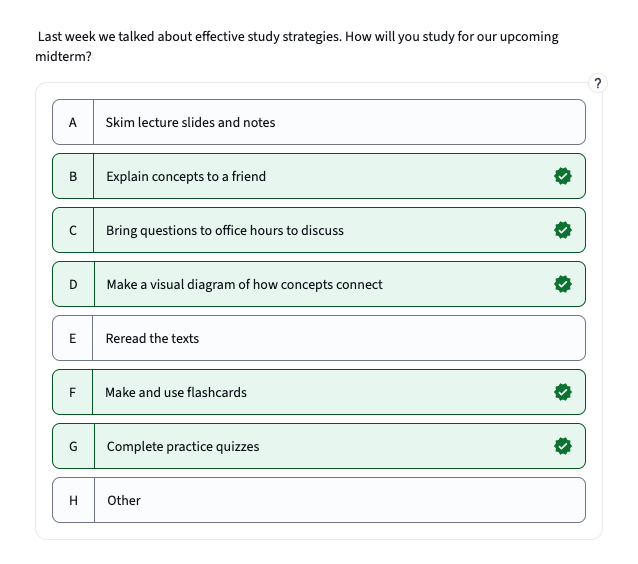
Top Hat multiple choice question with several correct answers that asks, “Last week we talked about effective study strategies. How will you study for our upcoming midterm?”
Facilitation Tips:
Pair this question with recommendations about successful study and coursework strategies.
For study strategies, reinforce that some strategies students rely on most, like re-reading, create familiarity without building recall of information. Study strategies that require effortful retrieval will be more effective.
Last Updated:
Did you know?
Once a month we feature simple tips for using Canvas and other campus tools more effectively.